

5 Basic Home Exercises After Knee Replacement


Knee replacement is a surgical procedure that significantly improves quality of life for patients with advanced knee osteoarthritis, pain, and limited motion. The success of the operation does not end on the operating table. One of the most critical elements of recovery after replacement is regular exercise and rehabilitation. The implant renews the joint surface, but a correct exercise program is essential for strengthening the surrounding muscles and regaining balance and movement control.
Home exercises, especially in the first weeks, increase independence, reduce pain, and help the replaced joint gain function more quickly. These exercises should of course be applied at the dose and frequency recommended by your doctor and physiotherapist. Every patient’s situation is different after surgery; it is therefore important to speak with your physician before doing the exercises below.
1. Sit-to-Stand (Squat-Like Control Exercise)
One of the most basic functions after knee replacement is being able to sit and stand safely. This movement is also an exercise that increases control and muscle strength in the knee.
How is it done? Stand in front of a chair or armchair. Position the feet hip-width apart, the back straight, and weight distributed equally on both legs. Slowly push the hips back as if sitting, taking care that the knees do not pass the toes. Then stand up again in a controlled way.
Points to watch
-
The knee joint should not collapse inward.
-
If pain increases during the movement, stop and consult your doctor.
-
In the first weeks you can start with a half sit rather than a full sit-to-stand.
Daily recommendation Start with 2–3 sets a day, 8–10 repetitions per set. You can increase the number of repetitions over time.
2. Knee Straightening (Quadriceps Set – Activating the Front Thigh Muscle)
One of the most common problems after knee replacement is that the front thigh muscle (quadriceps) cannot be used actively enough. This muscle is critical for straightening the knee and for stabilization while walking. The quadriceps set is one of the safest and most effective exercises that can be done in the early period after surgery.
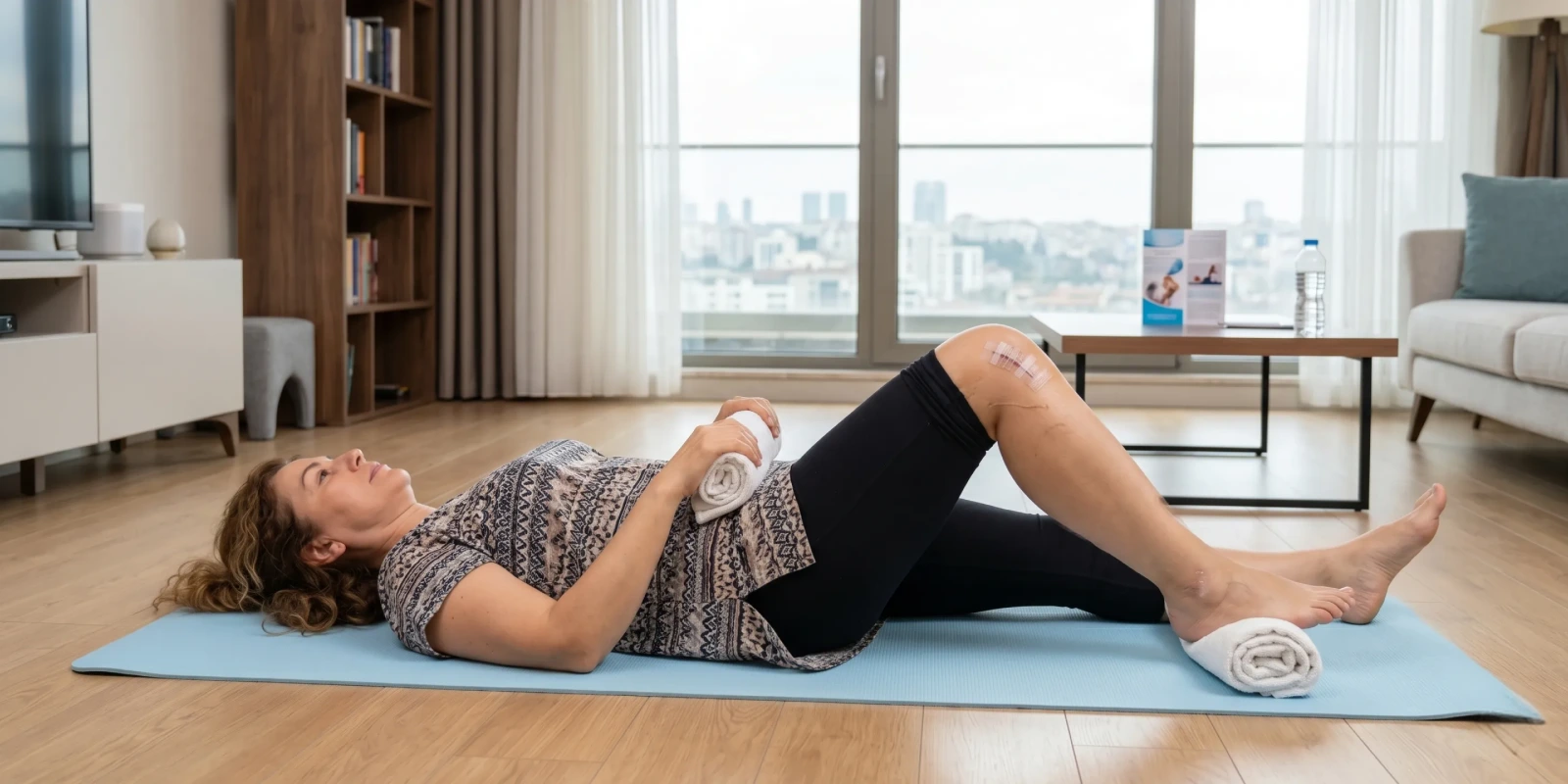
How is it done? Lie on your back or sit on a flat surface. Keep the operated leg straight. Tighten the thigh muscle and press the knee toward the floor to straighten it. Hold the muscle for 5–10 seconds, then relax.
Points to watch
-
Do not strain your hip or lower back while doing the movement.
-
If you feel pain in the knee, reduce the sets.
-
This exercise is very important for increasing muscle activation in the early period.
Daily recommendation It can be done 3–4 times a day, 10–15 repetitions each time.
3. Heel Slide (Increasing Knee Flexibility)
Gaining knee range of motion (especially flexion) after knee replacement is a critical step for return to daily activities. The heel-slide exercise increases bending and straightening of the knee in a controlled way.
How is it done? Lie on your back. Slowly slide the heel of the operated leg toward your hip and bend the knee. The other leg can stay straight. Progress the degree of flexion at the pain limit. Then slowly straighten the leg.
Points to watch
-
Do not do the movement in a hurry.
-
Stop if there is sudden pain or increased swelling in the knee.
-
A pulling sensation on the top of the knee during stretching is normal, but there should not be burning or sharp pain.
Daily recommendation It can be done in 2–3 sets a day, 8–12 repetitions per set.
4. Wall Leg Straightening (Quad Stretch – Balance of Back and Front Knee Muscles)
After knee replacement, balanced work of both the back and front knee muscles is important. This exercise increases flexibility of the muscles behind the knee while helping the knee straighten better.
How is it done? Lean your back against the wall and slide your heel toward the wall with the knee slightly bent. In this position try to straighten the knee and keep the muscles active. Hold for 5–10 seconds, then relax.
Points to watch
-
Do not go beyond your knee’s pain limit.
-
Do not strain your lower back while doing the movement.
-
If you feel stiffness in the knee, start with a shorter hold.
Daily recommendation It can be done twice a day, 8–10 repetitions each time.
5. Standing Leg Stretch and Hip Stabilization (Standing Hip Extension)
After knee replacement, strong hip muscles are needed for walking and balance. Hip stabilization reduces the load on the knee and makes walking safer. This exercise is ideal for strengthening the gluteal muscles at the back of the hip.
How is it done? Stand upright using a chair or wall for support. Lift the operated leg straight backward, moving from the hip. Keep your back straight and do not strain your lower back. Lift for 2–3 seconds, lower, and repeat.
Points to watch
-
Do the movement without rounding your lower back.
-
Do not lift the leg too high; control and pain-free movement come first.
-
If you have a balance problem, you can take extra support.
Daily recommendation Start with 2 sets a day, 10 repetitions per set.
5 Important Tips for Doing the Exercises Safely
The most critical point after knee replacement is “progressing without pain” and “continuing the movement without swelling or burning.” The following tips make the exercises safe and effective:
-
Warm-up: Warming up with 5–10 minutes of light walking or standing around before exercise helps the muscles work better.
-
Pain limit: Mild discomfort during exercise is normal, but sharp pain or increasing swelling indicates that the exercise dose should be reduced.
-
Cold application: Ice for 10–15 minutes after exercise can reduce swelling and pain.
-
Regular repetition: Small daily sessions are more effective than one long session.
-
Use of support: Using crutches or a walker in the first weeks is important for balance and safety.
Frequently Asked Questions
Frequently Asked Questions
Yes, it is safe at the dose recommended by the physician or physiotherapist. You should speak with your surgeon before starting the exercises.
Sit-to-stand, quadriceps set, heel slide, wall leg straightening, and standing hip stabilization are the five most basic exercises.
Usually 2–3 sets a day and 8–15 repetitions are recommended. Dose is adjusted according to the postoperative period and individual recovery.
Mild stretching and mild pain can be normal. With sharp pain, increasing swelling, or sudden strain, the dose should be reduced and a physician consulted.
Yes. Ice for 10–15 minutes after exercise can help reduce swelling and discomfort.
Using crutches or a walker in the first weeks reduces fall risk. How long support is used is determined by the physiotherapist and surgeon.
 WhatsApp
  Facebook
  Twitter
  Linkedin





 +90 505 398 34 34
 doctoryavuzarikan@gmail.com
 Book Appointment / Contact