

How Should I Sleep After Hip Replacement? Is a Pillow Between the Legs Required?


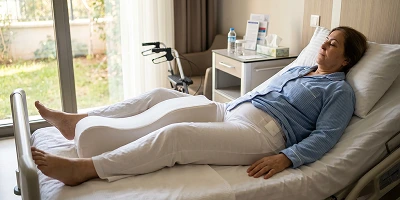
One of the questions patients ask most after hip replacement is “How should I sleep after hip replacement?” and “Is a pillow between the legs required?” Sleeping in the correct position after surgery is critical for preventing implant dislocation, reducing pain, controlling swelling, and speeding recovery.
This article covers sleeping positions after hip replacement, use of a pillow between the legs, movements to watch while lying down, and recommendations for sleeping safely.
The First Days After Hip Replacement: Why Sleeping Position Matters
In the first days after hip replacement, sleeping position is important for reducing the risk of implant dislocation. In the first 24–48 hours, healing of the tissues and muscles around the hip joint has only just begun. Positions that strain the hip should be avoided in this period.
The following positions are usually recommended in the first days:
- Lying on the back
- A semi-sitting position
- A position with the legs kept straight
These positions prevent excessive load on the hip and reduce pain.
Why Is a Pillow Between the Legs Recommended?
A pillow between the legs after hip replacement helps prevent the hip from turning inward (adduction) and the legs from coming together. This reduces the risk of dislocation. The pillow also increases pelvic stability and allows the patient to lie in a more comfortable position.
Benefits of a pillow between the legs include:
- Preventing the hip from taking an incorrect position
- Reducing the risk of implant dislocation
- Reducing pressure on the wound
- Providing a more comfortable sleeping position
Pillow use is not mandatory for every patient. Who should use a pillow depends on the surgeon’s recommendation and the type of surgery.
When Is a Pillow Between the Legs More Important?
Pillow use is especially important in:
- Patients at higher risk of dislocation after hip replacement
- The first few days after surgery
- Patients with a tendency for the hip to turn inward
- Patients at risk of the legs coming together while walking or lying down
- Operations performed through a posterior (rear) approach
In these situations, the pillow supports implant stability.
Sleeping Positions After Hip Replacement
Sleeping positions after hip replacement matter for safety and comfort. Recommended positions are described below.
1. Lying on the Back (Supine Position)
The safest position after hip replacement is usually lying on the back. The hip is held in a neutral position and dislocation risk is reduced. The legs are kept straight and a pillow is placed between them if needed.
Advantages of lying on the back:
- The hip remains stable
- Pressure on the wound is reduced
- Breathing is easier
- It provides a safe starting position for getting out of bed
2. Side-Lying (Lateral Position)
Side-lying may be more comfortable for some patients. There is, however, a risk of the hip turning inward and the legs coming together. A pillow between the legs is therefore recommended when lying on the side.
Points to watch in side-lying:
- The hip should not bend more than 90 degrees
- The legs should not touch each other
- The pillow should be placed between the knees
- The upper leg can be brought slightly forward to provide a stable position
3. Semi-Sitting Position
A semi-sitting position can provide comfort especially in the first days after surgery. The head and upper body are raised and the legs are kept straight. Excessive bending of the hip should still be avoided.
Advantages of a semi-sitting position:
- Breathing is easier
- Pain may decrease
- Pressure on the wound is reduced
Movements to Avoid While Lying Down
Some movements while lying down after hip replacement can increase dislocation risk. These should be avoided:
- Turning the hip inward
- Pulling the knees toward the chest (bending the hip 90 degrees)
- Crossing the legs
- Getting out of bed suddenly and without control
- Bending to the floor to pick something up
These movements are not recommended especially for the first 6–8 weeks after surgery. Following these rules for the period advised by the surgeon helps keep the implant stable.
Is a Pillow Between the Legs Required?
Pillow use is not mandatory for every patient, but it is recommended in many situations. It is useful especially in the first period for keeping the implant stable. The pillow prevents the legs from coming together and keeps the hip in a safe position.
Situations in which a pillow between the legs is required:
- Situations recommended by the surgeon
- Operations performed through a posterior approach
- Patients at higher risk of dislocation
- Patients who prefer a side-lying position
Pillow use usually continues for the first 6 weeks after surgery or for the period recommended by the surgeon. In some patients this period may be shorter or longer.
Tips That Make Pillow Use Easier
A pillow between the legs can sometimes be uncomfortable. When placed correctly, however, it provides comfortable sleep and a safe position. Tips include:
- Place the pillow between the knees without straining the hip
- The pillow should not be too high
- Choose a soft, supportive model
- A side pillow or strap can be used so the pillow does not slip
- In side-lying, bringing the upper leg slightly forward can stabilize the pillow
These tips help the patient lie more comfortably and safely.
Additional Recommendations for Sleep and Comfort After Hip Replacement
Sleep after hip replacement affects recovery. Good sleep helps reduce pain and supports the body’s recovery. The following suggestions can improve sleep quality:
- Raise the head of the bed slightly
- Adjust the position and number of pillows
- Keep pain control regular
- Plan night-time toilet needs (walker or support for the toilet)
- Do a light walk and breathing exercises before sleep
These suggestions help the patient have a more comfortable sleep.
How Long Should Sleeping-Position Rules Continue After Hip Replacement?
Sleeping position is usually a matter of care for the first 6 weeks after hip replacement. This period is important for implant settling and healing of surrounding tissues. In some patients the period recommended by the surgeon may be shorter or longer.
As a general rule:
- First 2 weeks: the most careful period
- 2–6 weeks: care continues, but movements increase slowly
- After 6 weeks: most patients can move to more comfortable positions
These times may change with the patient’s condition. Following position rules for the period recommended by the surgeon helps keep the implant stable.
Conclusion and Overall Assessment
The correct sleeping position after hip replacement is critical for implant stability and faster recovery. A pillow between the legs is recommended especially in the first period to reduce dislocation risk. Pillow use is not mandatory for every patient; it is planned according to the surgeon’s recommendation.
Following the recommendations of the surgeon and physiotherapist on sleeping position reduces complication risk and speeds recovery. A pillow between the legs is a useful method for maintaining the correct position and increasing comfort.
Frequently Asked Questions

Specialist Opinion
The correct sleeping position after hip replacement is critical for implant stability and faster recovery. A pillow between the legs is recommended especially in the first period to reduce dislocation risk. Pillow use is not mandatory for every patient; it is planned according to the surgeon’s recommendation.
Following the recommendations of the surgeon and physiotherapist on sleeping position reduces complication risk and speeds recovery. A pillow between the legs is a useful method for maintaining the correct position and increasing comfort.
Contact us to have your symptoms assessed and to learn about treatment options that may be right for you. Get in touch .
Frequently Asked Questions
In the first days, lying on the back or in a semi-sitting position is safe. The legs should be kept straight, and sudden turning and crossing the legs should be avoided.
It may not be mandatory for every patient, but it is recommended especially in the first days, when lying on the side, and in patients at higher risk of dislocation. Follow your surgeon’s advice.
The pillow prevents the legs from coming together (adduction) and reduces the risk of implant dislocation. It is especially important after a posterior approach.
With the surgeon’s approval, side-lying is possible with a pillow between the knees. The hip should not bend beyond 90 degrees, and sudden turning should be avoided.
It is usually used for the first 6 weeks or for the period set by the surgeon. The most critical period for most patients is the first 2 weeks.
Especially in the first 6–8 weeks, internal rotation, pulling the knees to the chest, crossing the legs, sudden getting up, and bending to the floor should be avoided.
 WhatsApp
  Facebook
  Twitter
  Linkedin






 +90 505 398 34 34
 doctoryavuzarikan@gmail.com
 Book Appointment / Contact